History
2006
-
Larry Brilliant wins TED Prize
Dr. Larry Brilliant, a well-known preventive medicine and public health physician with a strong interest in technology, conceived of the idea for InSTEDD for his "One Wish to Change The World" award at the TED Conference in 2006. During his TED Prize acceptance speech, Dr. Brilliant shared his wish to develop an early detection and early response system that would serve to warn the world of developing threats, saving more lives through earlier, more collaborative and more effective alerting and response.
InSTEDD was organized in 2006-2007 to serve as a catalyst to empower individuals and organizations by using technology for more effective action in early warning, prevention and response to disasters and public health threats. The founder's vision was to build an organization that would help make the world safer by making technological innovations accessible to humanitarian and public health organizations working to conquer complexities of some of the world's most challenging realities.
For his TED Prize acceptance speech Dr. Brilliant created, as a small joke, an acronym that contained "TED" and used the large red TED logo to build INSTEDD: "International Networked System for Total Early Disease Detection". Soon thereafter, his wish became our current 501(c)3 nonprofit (with a modified acronym) created with initial funding from Google?s philanthropic arm, Google.org, which was then headed by Dr. Brilliant.
Larry Brilliant wins TED PrizeDecember 16, 2010 -
InSTEDD founded
May 2006
InSTEDD was incorporated in the State of California with the goal of serving as a catalyst to empower individuals and organizations by using technology for more effective action in early warning, prevention and response to disasters and public health threats. The founders' vision was to build an organization that would help make the world safer by making technological innovations accessible to humanitarian and public health organizations working to conquer complexities of some of the world's most challenging realities.
InSTEDD foundedDecember 13, 2010
2007
-
InSTEDD participates in Golden Shadow
November 2007
InSTEDD participates in Golden Shadow exercise, a public health/humanitarian response demonstration performed with local organizations near InSTEDD's headquarters in California. This is an event held in parallel with the larger State of California exercise called Golden Guardian.
InSTEDD participates in Golden ShadowDecember 13, 2010 -
Mekong Collaboration Program established
November 2007
The Mekong Collaboration Program is established with funding from Google.org & Rockefeller Foundation to support Mekong region countries and the Mekong Basin Disease Surveillance (MBDS) Network.
Mekong Collaboration Program establishedDecember 13, 2010 -
Published Influenza Pandemic Preparedness and Response Manual
July 2007
Published and distributed Influenza Pandemic Preparedness and Response A Citizen's Guide (Flu Manual).
Published Influenza Pandemic Preparedness and Response ManualDecember 13, 2010 -
InSTEDD is awarded non-profit status by the US Government
June 2007
InSTEDD is awarded non-profit status by the US Government.
InSTEDD is awarded non-profit status by the US GovernmentDecember 13, 2010
2008
-
Avian Influenza Exercise using GeoChat
November 2008
First time use of GeoChat for a simulation exercise of Avian Influenza outbreak in Steung Treng Provence, Cambodia.
Avian Influenza Exercise using GeoChatJanuary 31, 2011 -
Agreement to start working in Mukdahan (Thailand) with ChangeFusion
November 2008
Agreement to start working in Mukdahan, Thailand, a key MBDS cross-border site with ChangeFusion as the implementing partner in Thailand.
Agreement to start working in Mukdahan (Thailand) with ChangeFusionDecember 14, 2010 -
Agreement to start working in Mukdahan, Thailand, a key MBDS cross-border site
November 2008
Agreement to start working in Mukdahan, Thailand, a key MBDS cross-border site.
Agreement to start working in Mukdahan, Thailand, a key MBDS cross-border siteDecember 14, 2010 -
ChangeFusion is identified as implementing partner in Thailand
ChangeFusion is identified as implementing partner in ThailandDecember 13, 2010 -
Decided to establish iLab (Innovation Lab) in Cambodia
August 2008
Under the guidance of Dr. Dennis Israelski, field visits to several of the Mekong Basin countries are completed and the decision is made to establish an innovation laboratory for field work in the Kingdom of Cambodia.
Decided to establish iLab (Innovation Lab) in CambodiaDecember 13, 2010
2009
-
Mesh4X and Epi Info Demo for US CDC
March 2009
We described an application of a light-weight synchronization platform for public health based on cloud computing and peer-to-peer architectures (Mesh4X). The significant value is demonstrated where epidemiologists can rapidly stand up a collaborative environment for data exchange and system interoperability, especially during outbreak investigation or responding to a disaster while operating in austere conditions.
Mesh4X and Epi Info Demo for US CDCJanuary 31, 2011 -
GeoChat tested in Thailand's Mukdahan province by ChangeFusion
February 2009
ChangeFusion starts working in Thailand's Mukdahan province, testing GeoChat and assessing needs.
GeoChat tested in Thailand's Mukdahan province by ChangeFusionDecember 14, 2010 -
Mekong Basin Disease Surveillance Network (MBDS) officially adopts GeoChat at a regional ICT strategy workshop
April 2009
- InSTEDD participates in the Information and Communication Technology (ICT) forum with the Mekong Basin Disease Surveillance network (MBDS). MBDS officially adopts GeoChat as a critical tool to support its mission to "build on past achievements to further enhance national and regional disease prevention and control".
- Global H1N1 (a.k.a. Swine Flu) outbreak announced.
Mekong Basin Disease Surveillance Network (MBDS) officially adopts GeoChat at a regional ICT strategy workshopDecember 14, 2010 -
Cambodia uses GeoChat for H1N1 outbreak and other key diseases
May 2009
- Cambodia starts using GeoChat with 100 staff to support information sharing related to the H1N1 virus (swine flu).
- Cambodia Center for Disease Control (CDC) uses GeoChat to send updates and information to Rapid Response Teams, starting with H1N1 alerting. As of mid-2010, the Cambodia CDC is continuing to use GeoChat for surveillance and response to outbreaks of acute diarrheal diseases.
Cambodia uses GeoChat for H1N1 outbreak and other key diseasesDecember 14, 2010 -
Agreement with MoH and NCHADS to develop an appointment reminder system for patients attending OI/ART clinics in Cambodia
September 2009
InSTEDD begins development of an appointment reminder system in partnership with Pangaea Global AIDS Foundation and the Cambodian Ministry of Health (MoH) and NCHADS. Pilot sites begin in the Siem Reap and Battambong provinces of Cambodia.
Agreement with MoH and NCHADS to develop an appointment reminder system for patients attending OI/ART clinics in CambodiaDecember 14, 2010 -
Health centers in Mukdahan, Thailand pilot GeoChat for ILI surveillance
October 2009
Health centers in Mukdahan, Thailand pilot GeoChat for influenza-like illness (ILI) surveillance and other surveillance and response priorities.
Health centers in Mukdahan, Thailand pilot GeoChat for ILI surveillanceDecember 14, 2010 -
Savannakhet Provincial Health Department (Lao PDR) starts using GeoChat
December 2009
MBDS cross-border site at the Savannakhet Provincial Health Department (PHD) starts using GeoChat to test for group communication improvement.
Savannakhet Provincial Health Department (Lao PDR) starts using GeoChatDecember 14, 2010
2010
-
Watchfire with American Red Cross and Cisco
In October of 2010, InSTEDD was awarded a seed grant from Cisco Systems for the development of a program to support public safety, self reliance, and situational awareness during a public crisis in the Bay Area.
In 2011, InSTEDD designed, developed, and pilot tested an emergency response team assembly tool called Watchfire, to help the American Red Cross (ARC) improve their community level disaster response in the San Francisco Bay Area. Working closely with the ARC on a needs assessment, we learned that their highest priority was improving the speed and coordination of ARC’s Disaster Action Teams (DATs). Using an agile development process that involved the ARC in the cycle of building better and better technical solutions, we developed Watchfire, a simple and yet powerful system that initiates and tracks the process of building a volunteer response team with people who are geographically close to each other through phone calls and text messages. InSTEDD’s commitment to Open Architecture (1 of our 3 basic principles) and the ability to scale our tools enabled Watchfire to be used through a customized version of Verboice.
LINKS:
http://instedd.org/blog/watchfire-video/
http://ndt.instedd.org/2011/09/live-recruiting-of-volunteers-through.html
Watchfire with American Red Cross and CiscoOctober 17, 2011 -
Thai Bureau of Epidemiology (BOE) starts using GeoChat for ILI hospital surveillance systems
January 2010
Thai Bureau of Epidemiology (BOE) starts using GeoChat to send out alerts and reminders as part of their nationwide influenza-like illness hospital surveillance system.
Thai Bureau of Epidemiology (BOE) starts using GeoChat for ILI hospital surveillance systemsDecember 14, 2010 -
InSTEDD team goes to Haiti to deploy EIS
January 2010
At the request of Thomson Reuters Foundation InSTEDD deploys Dr. Rasmussen and Director of Platform Engineering, Nicolas di Tada, to Haiti to deploy the AlertNet Emergency Information System.
InSTEDD team goes to Haiti to deploy EISDecember 14, 2010 -
GeoChat shortens detection and response times for public health responders during a serious dengue outbreak
January 2010
Mukdahan starts using GeoChat to support a serious dengue outbreak -- validates InSTEDD's approach to focus on multi-use tools.
GeoChat shortens detection and response times for public health responders during a serious dengue outbreakDecember 14, 2010 -
Shortcode for GeoChat announced in Thailand as a partnership between DTAC, ChangeFusion and InSTEDD
January 2010
Shortcode for GeoChat announced in Thailand as a partnership between DTAC, ChangeFusion and InSTEDD.
Shortcode for GeoChat announced in Thailand as a partnership between DTAC, ChangeFusion and InSTEDDDecember 14, 2010 -
InSTEDD participates in the first Bar Camp Yangon (Myanmar)
January 2010
InSTEDD participates in the first Bar Camp Yangon (Myanmar) -- at that point the largest Bar Camp in history with more than 3,000 participants.
InSTEDD participates in the first Bar Camp Yangon (Myanmar)December 14, 2010 -
ChangRai and its counterpart Bokeo, Lao PDR start using GeoChat
January 2010
ChangeFusion adds a second MBDS site in Thailand -- ChangRai and its counterpart Bokeo, Lao PDR -- to test GeoChat.
ChangRai and its counterpart Bokeo, Lao PDR start using GeoChatDecember 14, 2010 -
GeoChat used to strengthen Thailand's ILI surveillance
February 2010
ChangeFusion works with the Thai Bureau of Epidemiology to strengthen a nation-wide 800-hospital based Influenza Like Illness (ILI) surveillance effort using SMS alerts/reminders through GeoChat.
GeoChat used to strengthen Thailand's ILI surveillanceDecember 14, 2010 -
Web-based MBDS Scorecard is released to MBDS in partnership with RAND
March 2010
First iteration of the InSTEDD developed web-based MBDS Scorecard (which tracks MBDS progress towards their goals) is released to MBDS in partnership with RAND.
Web-based MBDS Scorecard is released to MBDS in partnership with RANDDecember 14, 2010 -
Official launching ceremony of NCHADS Appointment Reminder System
April 2010
Official launching ceremony of NCHADS Appointment Reminder System.
Official launching ceremony of NCHADS Appointment Reminder SystemDecember 14, 2010 -
Shortcode announced between InSTEDD and SMART mobile in Cambodia
April 2010
First general use shortcode announced between InSTEDD and SMART mobile in Cambodia to support GeoChat deployments and local innovation.
Shortcode announced between InSTEDD and SMART mobile in CambodiaDecember 14, 2010 -
GeoChat tested and deployed in Mekong region
April - May 2010
Many exciting GeoChat events took place this month, including:
- GeoChat fully translated into Lao language.
- InSTEDD deploys GeoChat at the provincial level in Cambodia.
- Bokeo Provincial Health Department (MBDS Cross-border site) started using GeoChat to support basic communication among provincial health staff and hospitals.
- Kampot Provincial Health Department (PHD) tested GeoChat for group communication.
- Kandal Provincial Health Department (PHD) started using GeoChat to support information-sharing between operational districts and health centers, as well as other communication needs.
- MBDS cross-border site in the ChiangRai, Thailand Province uses GeoChat to support communication with Surveillance and Rapid Response Teams (SRRTs), village health volunteers, livestock staff, provincial health staff and emergency medical response teams.
GeoChat tested and deployed in Mekong regionDecember 14, 2010 -
Office of Global AIDS Coordination announces PEPfAR-sponsored initiative "Health Informatics Public Private Partnership" with InSTEDD as part of the founding management team
May 2010
Office of Global AIDS Coordination Announces PEPfAR-sponsored initiative "Health Informatics Public Private Partnership" with InSTEDD as part of the founding management team.
Office of Global AIDS Coordination announces PEPfAR-sponsored initiative "Health Informatics Public Private Partnership" with InSTEDD as part of the founding management teamDecember 14, 2010 -
The "Reporting Wheel" is designed and implemented
July 2010
InSTEDD designs and implements the innovative "Reporting Wheel" to support formal reporting of diseases from health centers in Mukdahan, Thailand.
The "Reporting Wheel" is designed and implementedDecember 14, 2010
2011
-
UN-SPIDER Initiative
In November 2011, InSTEDD participated in the second expert meeting of the United Nations’s Space-based Information for Disaster Management and Emergency Response (SPIDER) initiative. The focus of this meeting in Geneva, Switzerland surrounded Crowdsource Mapping for Preparedness and Emergency Response.
Attending alongside InSTEDD were more than 70 leading experts representing crowdsource communities, space and remote sensing agencies, disaster management communities, NGOs, private companies, and regional and international organizations.
The UN-SPIDER program was established in 2006 in order to, "ensure that all countries and international and regional organizations have access to and develop the capacity to use all types of space-based information to support the full disaster management cycle."
LINKS:
UN-SPIDER InitiativeOctober 12, 2012 -
Launched Pollit: Real Time Poll Collections
In November 2011, we launched a new tool called Pollit.
Pollit is a free, open-source tool for conducting polls using text messages. Step-by-step, Pollit guides participants through polls and collects real-time results. Pollit shrinks the gap between audiences and pollers, taking the pulse of the people anytime and anywhere there's mobile phone service.
BLOGS
http://instedd.org/blog/introducing-pollit/
POLLIT WEBSITE:
Learn more about Pollit here: pollit.instedd.orgLaunched Pollit: Real Time Poll CollectionsOctober 12, 2012 -
Launched Remindem: SMS based Reminders
In October 2011, we launched a new tool called Remindem.
This tool lets you set up a schedule of tips, reminders or messages that will be sent via SMS to list subscribers. Like all of our tools, they can be used individually or paired with other tools to create more complete solutions.
Health care providers, professors or individuals can set up a system of unique, scheduled reminders which will be sent out via text message to subscribers. We imagine that applications of Remindem will vary across countries and communities, but it could look like a schedule of text messages for HIV prevention and safer sex tips for high risk communities or a set of appointment reminders, pre-natal development milestones and suggestions for eating healthy that a health care provider offers to all expecting mothers.
The possibilities are endless, only limited by your imagination! Remindem is not only free and open source but also integrates easily with many other technologies in our tool kit.
BLOGS
http://instedd.org/blog/why-we-love-remindem/
REMINDEM WEBSITE:
Learn more about Remindem here: remindem.instedd.orgLaunched Remindem: SMS based RemindersOctober 12, 2012 -
Launched Verboice: Interactive Voice Response System
In April 2011, we launched a new tool called Verboice. This interactive voice response system tool transcends language and literacy barriers by allowing anyone to create and run applications that interact via voice. This program enables users to listen and record messages in their own language and dialect.
VERBOICE IN DEVELOPMENT:
http://ndt.instedd.org/2011/11/verboice-listen-and-respond-to-voice-of.html
PROJECTS USING VERBOICE
Currently, Verboice is being used for Watchfire and Baby Monitor
VERBOICE WEBSITE:
Learn more about Verboice here: verboice.instedd.orgLaunched Verboice: Interactive Voice Response SystemOctober 12, 2012 -
TrueBites wins the Ashoka Changemakers Citizen Media Competition
November 2011
InSTEDD was honored to have the iLab Latin America idea be chosen as a finalist in the Ashoka Changemakers Citizen Media competition. TrueBites was an idea for a “new kind of news“ network where information is broken down into small bites that are brought together to create a multi-perspective story. In this multi-perspective story, the whole act of creation, curation, validation, verification and edition can be decentralized and set completely free of boundaries and roles.
TrueBites was one of four winners! A sincere thank you to everyone that supported this innovative idea from iLab Latin America.
BLOGS:
http://ndt.instedd.org/2011/10/new-kind-of-news.html
http://ndt.instedd.org/2011/11/truebites-wins-ashoka-changemakers.html
http://instedd.org/blog/citizen-media/
http://blog.ilabamericalatina.org/2011/12/truebites-nuestra-idea-de-plataforma-de.html (Spanish)
BIT BUCKET:
https://bitbucket.org/instedd/truebites
ASHOKA CHANGEMAKERS:
http://www.changemakers.com/citizenmedia/entries/truebites
TrueBites wins the Ashoka Changemakers Citizen Media CompetitionOctober 12, 2012 -
InSTEDD Awarded Grant by the Salesforce Foundation
The Salesforce Foundation gave a grant to InSTEDD for the development of a collaboration application that would facilitate the smooth coordination of information and resources during a disaster. Such a tool would enable an array of nonprofits, business, and government to communicate in real-time, share key information and coordinate resource provisioning.
As part of the grant, Salesforce made available its cloud-based messaging tool Chatter. Widely used by more than 150,000 organizations, Chatter has been well-tested, worked well to build upon and saved significant time, avoiding a program build from scratch.
InSTEDD was excited to join in Disaster Preparedness / Emergency Management planning focused on the South Bay Area of California. InSTEDD is a member of the Bay Area Cross-Sector Partners in Preparedness (BACSPP). This consortium is led by the American Red Cross Bay Area Chapter and also consists of Carnegie Mellon Silicon Valley’s Disaster Management Initiative.
InSTEDD Awarded Grant by the Salesforce FoundationOctober 12, 2012 -
OpenMRS Conference in Rwanda
October 2011
Channe Suy, product manager at iLab Southeast Asia traveled to Rwanda to participate in the OpenMRS community’s annual Implementers Meeting where she shared the iLab SEA's implementation experiences about working together to improve OpenMRS. Channe was invited to the conference because the iLab Southeast Asia and InSTEDD have worked closely with OpenMRS, contributing code and design expertise for the mobile integration of medical records. Additionally, in partnership with the Ministry of Health Cambodia, the iLab Southeast Asia is prototyping an OpenMRS system addressing maternal-transmission of HIV. Channe addressed how iLab Southeast Asia was using OpenMRS and the similarities between Rwanda and Cambodia.
LINKS:
http://instedd.org/blog/channe-at-openmrs-implementers-meeting/
OpenMRS Conference in RwandaOctober 12, 2012 -
InSTEDD participates in Pacific Endeavor
August 17, 2011:
Pacific Endeavor is a humanitarian communication workshop organized by the US Pacific Command. Its main goal is to improve communications in Humanitarian Assistance and Disaster Response situations; communication is seen as the foundation to a successful response.
Participants included all Southeast Asian militaries, NGOs, and industry leaders. InSTEDD participated in a workshop focusing on the Multinational Communications Interoperability Program (MCIP) initiative. The primary objective of MCIP is to establish a process that identifies and documents interoperability between communication systems.
LINKS:
http://instedd.org/blog/instedd-at-pacific-endeavor-2011/
http://www.cmu.edu/silicon-valley/dmi/news-events/news/2011/griss-speaks-pacific-endeavor.html
InSTEDD participates in Pacific EndeavorOctober 12, 2012 -
TB Alert System
In September of 2011, the iLab Southeast Asia began collaborating with Family Health International (FHI) and the National Center for Tuberculosis and Leprosy Control (CENAT) to improve the efficiency of reporting TB lab results to patients living in rural villages of the Kampong Cham province of Cambodia.
This program has three objectives:
1) To reduce turnaround time for delivery of laboratory test results through the use of SMS
2) To reduce access to care time within local villages through the use of SMS
3) To reduce the morbidity of TB through early detection and accelerated access to care
With the help of funding from USAID, we developed a custom reporting application that builds upon the SMS-based reporting functionality of GeoChat. In the SMS-based TB Lab Results Alert System, once the TB tests are analyzed, the results can be reported immediately to the health centers in real time using text messages on mobile phones. Real-time reporting means that patients with positive TB test results can be given medical treatment right away, as well as receive important education by village volunteers with specialized training about how to prevent spreading the disease to others.
PROJECT PAGE: http://www.ilabsoutheastasia.org/our-work/projects/
TOOL PAGE: http://www.ilabsoutheastasia.org/technologies/tb-lab-result-alert-system
BLOG: http://instedd.org/blog/2011-reflections/
FLICKR: http://flic.kr/s/aHsjCrUUfH
TB Alert SystemOctober 12, 2012 -
Malaria Day Zero Collaboration
In collaboration with The National Center for Parasitology, Entomology and Malaria Control (CNM), CamGSM Co. Ltd (also known as Mobitel) and funded by the Malaria Consortium (MC), the Malaria Day Zero Alert System was implemented in August 2011 as a pilot project in the Kampot,Kampong Cham and Siem Reap provinces of Cambodia. The Malaria Day Zero Alert System is a web-based application that enables health center staff (HC) and village malaria workers (VMWs) in provincial villages to report malaria cases via SMS text alerts to a centralized system. Once centralized, malaria case reports can be resent to areas where outbreaks are probable, as well as elevated up to the national level where emergency action can be taken if necessary.
In August of 2011, health care workers in the Kampot province of Cambodia were trained on the Malaria Day Zero web application with SMS text messaging for reporting malaria cases. Health care workers were also trained on the system and then provided with a solar cell and mobile phone in order to employ the reporting system while in the field.
About Malaria:
Malaria is the 5th cause of death from infectious diseases worldwide with sub-Saharan Africa and Asia accounting for 98% of global malaria deaths. Today, nearly half of the world’s population is considered at risk of contracting the disease. In areas with high transmission, such as Cambodia, the most vulnerable groups are young children, who have not developed immunity to malaria yet, and pregnant women, whose immunity has been decreased by pregnancy. The costs of malaria – to individuals, families, communities, nations – are enormous.
About the Tool:
The Malaria Day Zero Alert System is a web based application with SMS capabilities that enables health center workers and village malaria workers to report Malaria cases by sending a simple text message to the Malaria Day Zero Alert System. The cases are then automatically sent as SMS alerts to system administrators, supervisory health centers, operational districts (OD), Provincial Health Departments (PHD), as well as The National Center for Parasitology, Entomology and Malaria Control or CNM (formerly called National Malaria Center). The online system also provides the ability to view reports, manage users and places on a map, set up and send template messages, send alerts to groups or individuals, and set thresholds for the number of malaria cases to allow before reports are sent to supervisors. Once centralized, malaria case reports can be sent to areas where outbreaks are probable, as well as elevated up to the national level where emergency action can be taken if necessary.
The Malaria Day Zero Alert System connects to CamGSM’s network securely and in a scalable way through our Nuntium technology.
As of August 1, 2011 there are 17 Health Centers, 4 Operational Districts and 3 Provinces using the Malaria Day Zero Alert System system.
PROJECT PAGE: http://www.ilabsoutheastasia.org/our-work/projects/
TOOL PAGE: http://www.ilabsoutheastasia.org/technologies/malaria-day-zero-alert-system
BLOG: http://instedd.org/blog/2011-reflections/
FLICKR: http://flic.kr/s/aHsjvX44nt
Malaria Day Zero CollaborationOctober 12, 2012 -
InSTEDD Presents at TEDx Phnom Penh:
In February of 2011, Channe Suy, Product Manager of the iLab Southeast Asia, gave an inspiring talk about creating sustainable solutions to improve our future by building the capacity of local communities through knowledge sharing. Local capacity is one InSTEDD’s guiding principles and Channe was able to share our experience in this area through the work of the iLab Southeast Asia.
links:
http://instedd.org/blog/2011-reflections/
http://instedd.org/blog/from-the-ted-prize-to-tedxphnom-penh/
InSTEDD Presents at TEDx Phnom Penh:October 12, 2012 -
InSTEDD and NYC Department of Health partner on ECHO Project
In April 2011, we began working with the NYC Department of Health and Mental Hygiene (NYC DOHMH) on a project called ECHO: Electronic Communications for Health Organizations . The project was focused on helping the NYC DOHMH improve the ability of their Community Outreach Teams (COT) to gather emergency preparedness and response-related data in the field.
These Community Outreach Teams teams deploy into local communities in order to share information as well as capture location-based data from those communities. The goal of the ECHO project was to support the COT teams by allowing them to create and fill out electronic surveys on a handheld devices and then transmit that information back to the Emergency Operations Center for analysis - in near real-time.
Now, in situations that require an investigation (such as a potential disease outbreak) these teams will be able to create survey based forms and push them out to a team of people who each has their own Motorola Xoom tablet. The team will then collect answers to the survey by interviewing affected communities, and push them back to the server where they will later be able to export it to a Geographical Information System (GIS) tool.
LINKS:
Project Page: http://instedd.org/echo
The New Health Department also uses InSTEDD’s GeoChat tool: http://ndt.instedd.org/2011/08/mapping-alcohol-ads-with-geochat.html
InSTEDD and NYC Department of Health partner on ECHO ProjectSeptember 20, 2011 -
iLab Latin America is launched in Buenos Aires
In April 2011 we officially launched our second innovation lab! The iLab Latin America was born from our partnership with Manas, a Buenos Aires-based software development and consulting firm that we had already been working with on InSTEDD projects all over the world.
Through this collaboration, the iLab Latin America is helping NGOs, governments, social entrepreneurs and other organizations in Latin America design and use collaboration technology tools to better deliver critical services to vulnerable populations, while building and optimizing their technological capacities to support their humanitarian work.
The goal of the iLab LatAm is to be to create a center for technological innovation tailored to the region’s unique health, safety and sustainable development needs.
In 2007, InSTEDD started the first iLab in Phnom Penh, Cambodia, iLab Southeast Asia, with the goal of building technical capacity for addressing health, safety and development issues in the Mekong Basin. The iLab Latin America, InSTEDD’s second iLab, was launched after the InSTEDD/Manas team identified specific needs within the Latin American cultural context to customize existing tools and develop new solutions in partnership with local communities.
In addition to providing collaboration technology consulting services to its partners, the iLab Latin America serves as a research and innovation space where public and private organizations across Latin America have the opportunity to proactively channel their questions and concerns in regards to social and humanitarian matters that would benefit from the implementation of information technology.
To learn more about the iLab Latin America, please visit the Spanish language website.
iLab Latin America is launched in Buenos AiresApril 20, 2011
2012
-
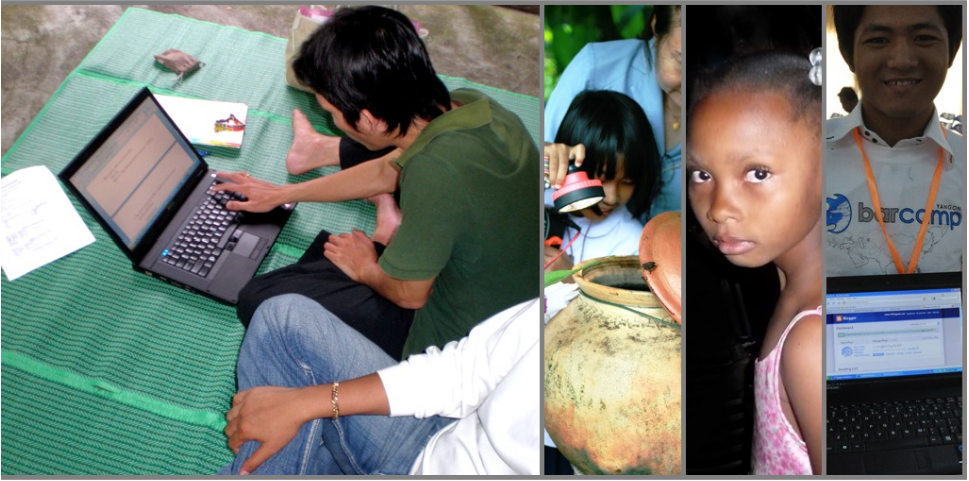
iLab SEA Participates in BarCamp Yangon 2012
BacCamps have taken place all over the region, including Cambodia, Thailand, Malaysia, Vietnam, Singapore, Laos and Myanmar. In fact, the largest BarCamp event to ever take place was BarCamp Yangon (Myanmar), with an estimated attendance of over 5,000 people! BarCamp Yangon was such a significant event that the opening address was made by Nobel Peace Prize Laureate and opposition leader Aung San Suu Kyi, known affectionately as “the Lady.”
In 2012, some of the iLab Southeast Asia staffs traveled to Myanmar to participate in BarCamp Yangon 2012. Mesa, an iLab Southeast Asia Developer, gave a presentation on "Test Driven Development (TDD)" to about 50 people.
Yon, the iLab Southeast Asia Field Support Staff Officer, also gave a presentation on "Technology and Grassroots level users" to about 20 people.
Since part of our mission at InSTEDD is focused on capacity building, we have been a huge supporter of BarCamp over the years. We have sponsored several events and even hosted Mini-BarCamp events at the iLab Southeast Asia.
iLab SEA Participates in BarCamp Yangon 2012October 12, 2012 -
Environmental Youth-led Risk Mapping Project
Working alongside UNICEF, MIT and the Brazilian NGO CEDAPS, the iLab Latin America is helping develop the Environmental Youth-led Risk Mapping Project in the favelas of Rio de Janeiro, Brazil. This cutting-edge mapping platform enables real-time data collection through web and mobile applications.
The main goal of this project is to highlight the environmental risk factors that threaten the community in a way that gains visibility in order to encourage federal and local authorities to deal with those threats.
The InSTEDD iLab Latin America has contributed to solving technical issues on the platform, simplify the interface of the application as well as increasing the usability of the tool.
PROJECT PAGE:
instedd.org/map/favela-digital-mapping
BLOGS:
http://instedd.org/blog/ilablatam-digital-mapping-rio-de-janeiro-part-1/
FLICKR:
Environmental Youth-led Risk Mapping ProjectOctober 12, 2012
instedd.org/about-us/history/